

Dynamic Discounts and Early-Pay Incentives with Stablecoins

Dynamic Discounts and Early-Pay Incentives with Stablecoins
Early‑pay incentives paired with stablecoins let finance teams unlock cash faster, at lower cost, and with far greater control than static terms. By pricing time in real time and settling value instantly, businesses can steer pay‑downs to the days that maximize liquidity while cutting errors and disputes. That combination stabilizes cash flow and reduces working capital needs.
Research says the payoff is big. Working capital programs commonly reduce the cash needed to run a business by 20 to 30 percent. Dynamic discounting is one of the fastest levers because it converts idle cash into risk‑free returns while improving supplier liquidity. In short, using stablecoins to capture early payment discounts is built for CFO‑grade cash discipline, not crypto speculation. (mckinsey.com)
What Are Stablecoins and How Do They Fit Business Payments?
Stablecoins are digital tokens designed to hold a steady value, typically one token equal to one unit of fiat currency such as the U.S. dollar. For business payments, their value comes from programmability and speed. Properly designed, fiat‑backed coins can settle in seconds, operate 24/7, and embed rules right inside the payment itself. That means a discount can be calculated, agreed, and settled at the exact moment goods are received. Global research bodies frame the promise and the caution: stablecoins can enable faster, programmable payments, but risk management and sound backing are essential. (bis.org)
In plain terms, stablecoins are not “just another crypto.” They target price stability by linking to reserves. The usual types are fiat‑backed (reserves of cash and Treasury bills), crypto‑backed (overcollateralized with other tokens), and algorithmic (rules‑based supply adjustments). For business payments, policy makers increasingly focus on “payment stablecoins,” usually fiat‑backed with clear redemption rights and reserve transparency. The United States’ 2025 GENIUS Act set a federal framework for payment stablecoins, clarifying that issuers must meet specific prudential and compliance standards. That opened the door for corporates to evaluate them as a serious settlement instrument for early‑pay programs too. (brookings.edu)
Scale now matters. On‑chain data shows stablecoin transaction volumes and active users have surged, with dollar‑pegged coins like USDT and USDC dominating transfer activity. Visa’s on‑chain analytics and independent analyses show monthly adjusted stablecoin volumes in the trillions, which speaks to real settlement demand, not just trading. For a CFO, that scale signals maturing rails that can carry meaningful payables and support early settlement choices. (corporate.visa.com)
Two practical notes for treasurers. First, not every token suits payments. Look for fiat‑backed, redeemable coins with public reserve reporting and a history of smooth redemptions. Second, treat stablecoins as a payment instrument, not a yield vehicle. The strongest designs emphasize par redemption, transparent reserves, and compliance controls, not speculative returns. As Brookings analysts write, the goal is a “safe, trusted, and high‑integrity payment instrument.” (brookings.edu)
So what does this mean for your cash flow? With a programmable unit of value, you can hard‑code incentives into payment flows. That is where dynamic discounts start to get interesting, especially when paired with crypto rails for settlement optionality.
What Are Early Payment Discounts and Where Do They Help?

Early payment discounts exchange time for price. Classic terms like 2/10, net 30 offer a 2 percent reduction if the buyer pays within 10 days, otherwise the full amount is due in 30. For the supplier, that brings cash forward. For the buyer, it reduces cost of goods. The finance nuance many overlook is the implicit yield. A 2 percent discount taken 20 days early equates to roughly a 36 percent annualized return. That is why discount capture is one of the cleanest, risk‑free returns in working capital, whether settlement lands by ACH or with a stablecoin like USDC. (accountingcoach.com)
Static discounts, though, are blunt instruments. They assume every supplier values cash the same on day 10 and every buyer’s liquidity is predictable through day 30. Reality disagrees. Cash balances swing. Demand shocks happen. Suppliers’ need for cash spikes at quarter‑end. Buyers’ cost of funds changes with rates. Studies and industry surveys show many firms leave money on the table by either missing discounts, paying early without taking them, or applying one‑size‑fits‑all terms that do not map to real conditions. (cfo.com)
There is also a relationship angle. Static terms can feel take‑it‑or‑leave‑it. Some suppliers will not discount at 2 percent but would happily take 1.2 percent on day 17 before payroll, or 0.6 percent on day 24 to restock inventory. Others want no discount this cycle but would trade next month. Flexibility builds goodwill that translates into priority allocation and fewer painful renegotiations when markets tighten. See the difference?
For accounting teams, early payment discounts are straightforward to book under either the gross or net method. The gross method records the full invoice and recognizes the discount when taken. The net method records the discounted amount up front, then trues up if the discount is missed. Both are standard approaches in U.S. accounting education and practice. (accountingcoach.com)
Static models help, but they cap your upside. The next section explains how to make discounts move with you.
How Do Dynamic Discounts Work in Practice?
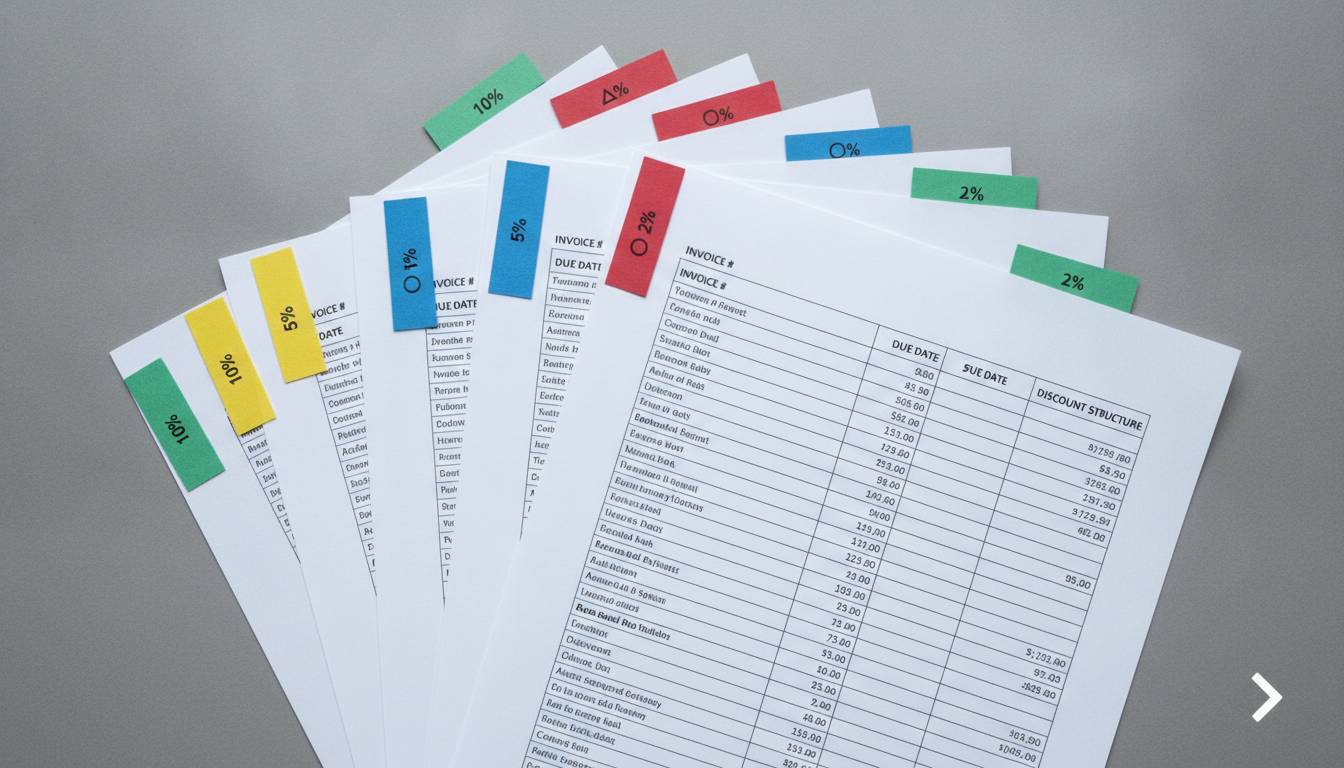
Dynamic discounts price time continuously instead of in a single window. The discount rate changes with days outstanding, with your cost of cash, and with a supplier’s liquidity preferences. Think of it as a live marketplace where both sides can choose the point on the curve that creates the most value right now. That flexibility is why dynamic programs are associated with faster cash conversion and higher discount capture. Several banks and working capital platforms describe dynamic discounting as a way to shift between funding sources and fine‑tune rates in near real time. (jpmorgan.com)
Mechanics. You set a discount curve, for example 2 percent at day 10, linearly decaying to 0 percent at day 30. Suppliers can request early payment at any point along that curve after invoice approval. Buyers can fund with their own cash or third‑party liquidity. Modern tools push this further: they ingest real‑time data such as forecast balances, market yields, supplier risk, and even seasonality to suggest optimal offers. That turns discounting from a passive setting into an active portfolio of micro‑decisions that protect cash while lowering COGS. (support.taulia.com)
Here is how it actually plays out. Before, your AP team offered 2/10, net 30 and paid most suppliers on day 30, occasionally missing the window or paying early without a discount. After, you publish a dynamic schedule visible in the supplier portal. A vendor that needs cash for payroll on day 18 takes a 0.8 percent discount. Another that does not need cash declines. You de‑risk supply without overpaying for time. Discount yield climbs because the program now meets your counterparties where they are.
What about crypto rails? Dynamic discounting does not require crypto. But when you pair dynamic terms with stablecoin settlement, you eliminate bank‑hour frictions and wire cut‑offs. If a supplier accepts USDC, your early payment can settle in minutes, including weekends. That speed lets you push decisions later without missing windows, so you capture more yield with less liquidity drag. Visa’s on‑chain analytics and Federal Reserve research both point to stablecoins’ growing role in cross‑border and always‑on settlement. This is where dynamic discounting with crypto rails becomes practical for AP teams. (corporate.visa.com)
Mini‑example, “2/10 net 30 USDC” as a sliding curve. Offer 2 percent if paid by day 10, linearly decreasing to 0 percent by day 30, with settlement in USDC. A supplier chooses day 17 and receives 1.3 percent less than face value in exchange for immediate USDC. You lock in a risk‑free reduction in COGS, the supplier funds inventory promptly, and both of you skip weekend bottlenecks. If your treasury cost rises next month, you widen the curve only for the categories that still clear your hurdle.
Comparison, static vs dynamic models:
| Model Type | Flexibility | Data Utilization | Cash Flow Impact |
|---|---|---|---|
| Static discount (for example, 2/10, net 30) | One window, fixed rate | Minimal, set once per contract | Good if captured, but often missed and mispriced |
| Dynamic discount | Many points along a curve | High, can ingest cash forecasts, supplier signals, market yields | Stronger capture, faster conversion, better fit to liquidity |
💡 Pro Tip
Consider using real‑time analytics to adjust discount rates within guardrails tied to your cost of funds. When cash tightens, narrow windows or shift some offers to financed options. When cash is abundant, widen the curve to harvest more discount yield.
Why Do Stablecoins Improve Discount Programs?
Stablecoins and dynamic discounting reinforce each other. Early payment incentives price time. Stablecoins compress time. When you remove bank‑hour cutoffs, weekend gaps, and cross‑border FX holds, you can push decision making closer to delivery acceptance and still meet offer windows. The result is more captured discounts with less idle cash. Visa’s on‑chain datasets show trillions in adjusted monthly stablecoin volume, and Chainalysis data shows stablecoins dominate crypto transfer activity by value, which indicates mature rails for value movement. (corporate.visa.com)
Three practical advantages stand out. First, settlement speed. USDC or PYUSD can settle in seconds or minutes, which reduces the chance of missing a discount window because an ACH batch missed a cutoff. Second, programmability. You can embed rules that release payment when a receiving event matches a purchase order, which reduces disputes and post‑facto reconciliations. Third, transparency. Blockchains create tamper‑evident audit trails that make it easier to resolve exceptions and reduce duplicate payments or fraud, a benefit repeatedly highlighted in enterprise studies. (www2.deloitte.com)
Compliance and clarity matter. In July 2025, the U.S. enacted the GENIUS Act, creating a federal framework for payment stablecoins and setting expectations for reserves, redemption, and AML programs. That legislative clarity is why many finance leaders now treat fiat‑backed stablecoins as a viable settlement instrument while continuing to monitor bank‑issued deposit tokens. As Brookings summarized, the point is to build a safe, trusted instrument for payments, not a speculative asset. (brookings.edu)
One expert view captures the promise. As Brookings authors Nellie Liang and William Dudley wrote, “As a new payment instrument, they would bring cheaper, faster, and more efficient payments based on blockchain ledger technology.” The quote matches what treasury teams experience when they see weekend settlements and instant confirmations in their dashboards. (brookings.edu)
We have also heard a frequent concern: fraud and illicit finance. The latest Chainalysis report estimates illicit crypto volume below 1 percent of all attributed activity, and regulators are tightening standards for payment stablecoins. That does not remove risk, but it does put it in context and underscores why governance, whitelisting, and custodial controls belong in your design. (chainalysis.com)
At our shop, we built the SeevCash App to let buyers publish dynamic offers and settle in fiat or stablecoins like USDC when suppliers opt in, because many teams want the optionality to switch rails without ripping out AP workflows. Other tools exist, and any you use should make accounting export simple and give treasury controls over APR guardrails.
How Can Businesses Implement Stablecoin-Based Discounts?
Start with policy, then plug in technology. First, write the rules. Define which suppliers and categories are eligible, what your minimum acceptable APR is, and how discount curves should change with cash forecasts. This is where finance leads and procurement aligns incentives. Next, pick the payment rail. For domestic runs, bank rails may suffice. For weekend‑heavy or cross‑border cycles, evaluate a fiat‑backed stablecoin with clear reserve disclosures and mature on‑ and off‑ramps. Circle and Paxos publish regular reserve reports for USDC and PYUSD respectively, which is the benchmark level of transparency to expect from issuers. (circle.com)
Then integrate. Your ERP or payables platform should expose dynamic schedules to suppliers, calculate sliding discounts, and post entries to the GL under your chosen accounting method. From there, layer in analytics to forecast take‑rates and to simulate yield under different curves. Banks that support dynamic discounting often allow you to toggle between buyer‑funded and financed options, which helps when you want to preserve cash near quarter‑end without shutting off early‑pay offers altogether. (jpmorgan.com)
A step‑by‑step path many mid‑size teams follow:
-
Frame the economics. Use last year’s AP ledger to model discount capture at several curves, applying your current cost of funds as the hurdle. Include a baseline “static 2/10, net 30” run for comparison. A small curve shift often moves the needle more than expected because it meets suppliers’ true cash peaks.
-
Choose tokens and custody. If the use case is U.S. supplier payments, shortlist USDC and PYUSD due to reserve transparency and broad support. Set up a business wallet with enterprise controls and segregation of duties. Document redemption paths back to fiat to avoid balance creep. (circle.com)
-
Pilot with willing suppliers. Start with 10 to 20 vendors that already accept bank discounts. Offer a “2/10 net 30 USDC” curve, explain their options in plain English, and commit to weekend settlement support. Ask for feedback on the shape of the curve after two cycles.
-
Lock down accounting and audit trails. Decide gross versus net method for discounts. Confirm that your tooling can export journal entries with clear identifiers, including fiat value at settlement time for any stablecoin runs. Accounting references widely describe both methods and their entries, so this step is about consistency and audit readiness. (accountingcoach.com)
-
Monitor and tune. Track discount yield, capture rate, cash conversion, and supplier satisfaction. External research places the attainable impact of working capital programs in the 20 to 30 percent range on cash needed to run the business, and dynamic discounting often outperforms static terms on both capture and relationships. If the curve performs below target, adjust the slope for categories where suppliers need cash most. (mckinsey.com)
Two extra considerations. First, bank products vs stablecoins. Some banks do not issue public stablecoins but offer deposit tokens for institutional clients, like JPM Coin, which is explicitly a bank‑issued deposit token, not a cryptocurrency. For CFOs, that means you can mix rails. Use deposit tokens where available for intraday liquidity and payment routing, and use compliant stablecoins where you want open‑network reach. Second, governance. Set counterparty whitelists, require verified business wallets for settlement, and align with your AML/KYC program. (jpmorgan.com)
If you want help setting guardrails and analytics, we offer SeevCash Plus for treasury teams that want programmable curves, issuer selection, and auto‑reconciliation into common ERPs. Other vendors can help too. Pick the tool that your AP and accounting leaders can audit comfortably and that your suppliers will actually use.
Common Questions About Early Payment Discounts and Stablecoins
What are the risks associated with using stablecoins for payments?
There are three to watch. First, issuer risk. You want coins with transparent reserves, strong redemption mechanics, and regular attestations. Second, policy risk. The GENIUS Act introduced a federal framework in July 2025, but details will continue to evolve as agencies finalize rules. Third, operational risk. Always‑on payments are fast, which calls for better controls around whitelists and approvals. Leading policy research and central bank reports stress that payment stablecoins can support faster settlement if backed by sound risk management and compliance programs. (brookings.edu)
How can businesses measure the effectiveness of dynamic discounts?
Look at cash and relationships together. Core metrics include discount capture rate, discount yield versus hurdle APR, DPO impact, percent of invoices paid early, and supplier satisfaction. Working capital studies show significant improvements when programs move from static to data‑driven terms. You can also instrument a control group on static terms for one quarter to compare capture, then roll out the winning curve. Finance publications and research communities repeatedly cite discounting as a reliable path to unlock trapped liquidity when paired with analytics and clear ownership. (mckinsey.com)
Can all types of businesses implement dynamic discounts with stablecoins?
Most can, but fit varies. If you have many small suppliers on thin margins, design gentle curves that trade less margin for more predictability. If you run heavy cross‑border payables, stablecoins help on weekend and time‑zone coverage. Firms in highly regulated sectors should coordinate with counsel and banking partners. The right approach often blends bank rails for some flows and stablecoins for others, informed by cash forecasts and supplier feedback. Policy work at Brookings and real‑world volumes tracked by Visa show growing space for payment‑grade stablecoins alongside bank tokens. (brookings.edu)
What technology is needed to integrate stablecoins into payment systems?
At minimum, a business wallet that supports your chosen coin, ERP or AP software that calculates dynamic discounts, and reporting that can export journal entries with fiat equivalence at settlement. Many platforms now embed stablecoin settlement next to ACH and wires, so AP can pick rails per invoice. For larger programs, add analytics that pull cash forecasts and supplier signals into the curve. NIST’s technical guide and enterprise case studies provide helpful taxonomies and integration considerations. (nist.gov)
What are payment stablecoins?
Payment stablecoins are fiat‑redeemable tokens used for everyday transactions, subject to specific rules on reserves, redemption, and compliance. In the U.S., the GENIUS Act of 2025 defined this class and directed regulators to finalize user protection and AML standards. The term generally excludes algorithmic coins and focuses on redeemable, fiat‑backed instruments. That clarity is why more treasury teams are exploring them for settlement alongside bank products. (brookings.edu)
What banks offer stablecoin or similar services?
Few U.S. banks issue public stablecoins for retail or supplier payments. Large institutions do offer deposit tokens for institutional clients. Example: JPM Coin is a bank‑issued USD deposit token, not a cryptocurrency or public stablecoin, used for real‑time transfers among approved clients. Many banks also support dynamic discounting through financed options and ERP integrations. For open‑network settlement, most firms rely on non‑bank issuers like Circle (USDC) or Paxos (PYUSD) and convert back to deposits as needed. (jpmorgan.com)
How to record a discount for early payment?
Pick a method and stay consistent. Under the gross method, the seller books full revenue and recognizes the discount when paid early, and the buyer books full AP then recognizes the discount at payment. Under the net method, both parties record the discounted amount initially and adjust if the discount is missed. Most accounting references present both as acceptable. Coordinate with your auditor before switching methods mid‑year. (accountingcoach.com)
What are the best stablecoins for paying suppliers right now?
If your goal is paying suppliers, think “most reliable to settle,” not “best to buy.” Look for fiat‑backed coins with transparent reserves and regular attestations, such as USDC and PYUSD. Both issuers publish reserve reports and emphasize 1:1 redemption, which is what matters for payments. Your policy should set who can hold tokens, for how long, and when to redeem back to dollars. This is not investment advice. (circle.com)
Where To Start Today
Run a 30‑day pilot with five suppliers. Offer a simple dynamic curve, for example 2 percent at day 10 decaying to 0 percent at day 30, plus weekend settlement in USDC for those who opt in. Measure capture rate, realized APR versus hurdle, and supplier satisfaction. If you want a template, we can share ours.
At SeevCash we can help you design discount curves, set APR guardrails, and settle in fiat or stablecoins side by side. If you prefer to build with another stack, use the same playbook: start small, add analytics, and tune by data. The good news? When time has a price and settlement has no closing bell, your cash flow starts to follow your plan, not your calendar.
Sources and notes:
- Working capital reductions of 20 to 30 percent refer to McKinsey analyses of working capital programs. (mckinsey.com)
- Stablecoin definitions and policy framing draw on BIS, Brookings, and NIST references. (bis.org)
- Volume and usage signals reference Visa’s on‑chain analytics and Chainalysis adoption data. (corporate.visa.com)
- Accounting treatments reflect standard references on early‑pay discounts. (accountingcoach.com)
- Blockchain transparency benefits reference Deloitte and WEF sources. (www2.deloitte.com)
Compliance reminder: Laws and guidance evolve. For U.S. readers, the GENIUS Act of 2025 created a federal framework for payment stablecoins and agencies continue to finalize rules. Confirm requirements with counsel before production use. (brookings.edu)