

How to Invoice in USDC and Reduce Payment Delays

How to Invoice in USDC and Reduce Payment Delays
The fastest way to cut invoice lag is to shift your billing to USDC, add it as a payment option, include chain and address details on every bill, and let clients pay in minutes instead of days. That single change removes banking cutoffs, trims fees, and reduces failed payouts, so you get paid sooner with fewer surprises. It is one of the simplest ways to get paid faster with stablecoins while keeping dollar pricing.
Late payments choke small businesses. The average U.S. small business with unpaid invoices is owed more than $17,000, locking up cash you could use for payroll or growth. Reducing time to cash is the lever that matters. Stablecoins, especially USDC, settle quickly and at low cost, which unlocks working capital. According to QuickBooks’ 2025 Small Business Late Payments Report, outstanding balances at this scale are now common; businesses that shorten payment cycles relieve real pressure on hiring and operations. (quickbooks.intuit.com)
You’re here because wire timing and card settlement keep slipping. ACH says “1–3 business days” but weekends, bank cutoffs, and return windows stretch that into next week. Meanwhile swipe fees nibble 2–3% off revenue. Switching your invoices to USDC does not require your clients to become crypto experts, it simply gives them a dollar‑denominated way to pay you faster, any day, any hour. (nacha.org)
What is USDC?
USDC is a digital dollar that lives on public blockchains and aims to maintain a constant $1 value. Each token is designed to be fully backed by high-quality dollar assets, with monthly reserve reporting under AICPA attestation standards, so holders can treat it like a programmable dollar for payments and settlement. Because it moves on open networks, it clears any time of day without bank hours. That makes it a practical tool for invoicing when you want speed, finality, and transparent tracking. (circle.com)
At its core, USDC is issued by Circle and operates on dozens of blockchains, including Ethereum, Base, Solana, Polygon, and others. That broad support matters for invoicing because you can choose a network with fast confirmation and low fees, then standardize your invoice template around it. Think of USDC as a dollar with an API. It behaves like money and plugs into software, web links, QR codes, and automated workflows that shrink invoice friction. Circle’s public documentation lists native deployments and emphasizes instant, low-cost settlement across networks. (circle.com)
How does the $1 peg work in practice? Two forces keep USDC close to a dollar, reserves and the mint-and-redeem loop. Reserves are held in cash and short-duration U.S. Treasuries or overnight reverse repos via the Circle Reserve Fund, and monthly reports are published. If USDC drifts from $1 on exchanges, arbitrageurs can redeem tokens for dollars or mint new tokens against dollars, nudging the price back toward parity. This is the same economic logic that ties money market fund shares to $1. The emphasis on dollar-backed assets and regular disclosures is what makes USDC feel familiar to finance teams. (circle.com)
Where does USDC fit in the broader crypto ecosystem? It is the settlement asset for many on-chain payments. Chainalysis reports stablecoins now account for a large share of crypto transaction activity, reflecting real-world usage beyond trading. Visa launched an on-chain settlement pilot with USDC and has expanded it for U.S. partners, signaling growing mainstream rails for digital dollars. For invoicing, that means fewer hops. Your client sends USDC, your wallet receives it, and the funds are ready to use on-chain, often in seconds on certain networks. (chainalysis.com)
A common concern is speed across different chains. Historically, moving USDC between chains took minutes. Circle’s protocol update reduced cross-chain settlement time to seconds in many cases, removing the bottleneck when clients hold balances on another network. For invoicing, you can specify one network on the bill, but it helps to know cross-chain options exist if your counterparties prefer a different chain. (theblock.co)
Here’s a simple analogy. If traditional payments are like mailing a check that waits for the post office and the bank, USDC is like sending a verified email with a read receipt. It shows up fast, it is traceable on a public ledger, and it does not pause for weekends.
What is a crypto invoice?
A crypto invoice is a standard bill that lists deliverables, price, due date, and terms, but it also includes on-chain payment details, the token (USDC), the network (for example, Solana), and the recipient address or payment link. Many teams add a QR code and a unique memo or reference field to match payments automatically. For templates and must-have fields, see our deep dive on what to include in a crypto bill. (theblock.co)
Can I invoice in USD?
Yes. Invoicing with USDC is invoicing in dollars, because USDC targets a $1 peg and is redeemable with the issuer. You list the amount in USD, then specify USDC as the payment method. Your client pays $1 in USDC for every $1 owed, and you receive the same dollar value in token form. Circle’s documentation explains USDC’s design as a dollar-denominated asset intended for payments and settlement. (developers.circle.com)
What does USDC mean for payment?
It means near-instant, programmable settlement using a dollar-pegged token. For your business, that reduces days waiting for ACH or card batches and cuts costly chargeback and return windows tied to legacy rails. Visa’s expansion of USDC settlement signals that payment networks are starting to treat digital dollars as part of core operations. (corporate.visa.com)
What are the real benefits of using USDC for invoicing?
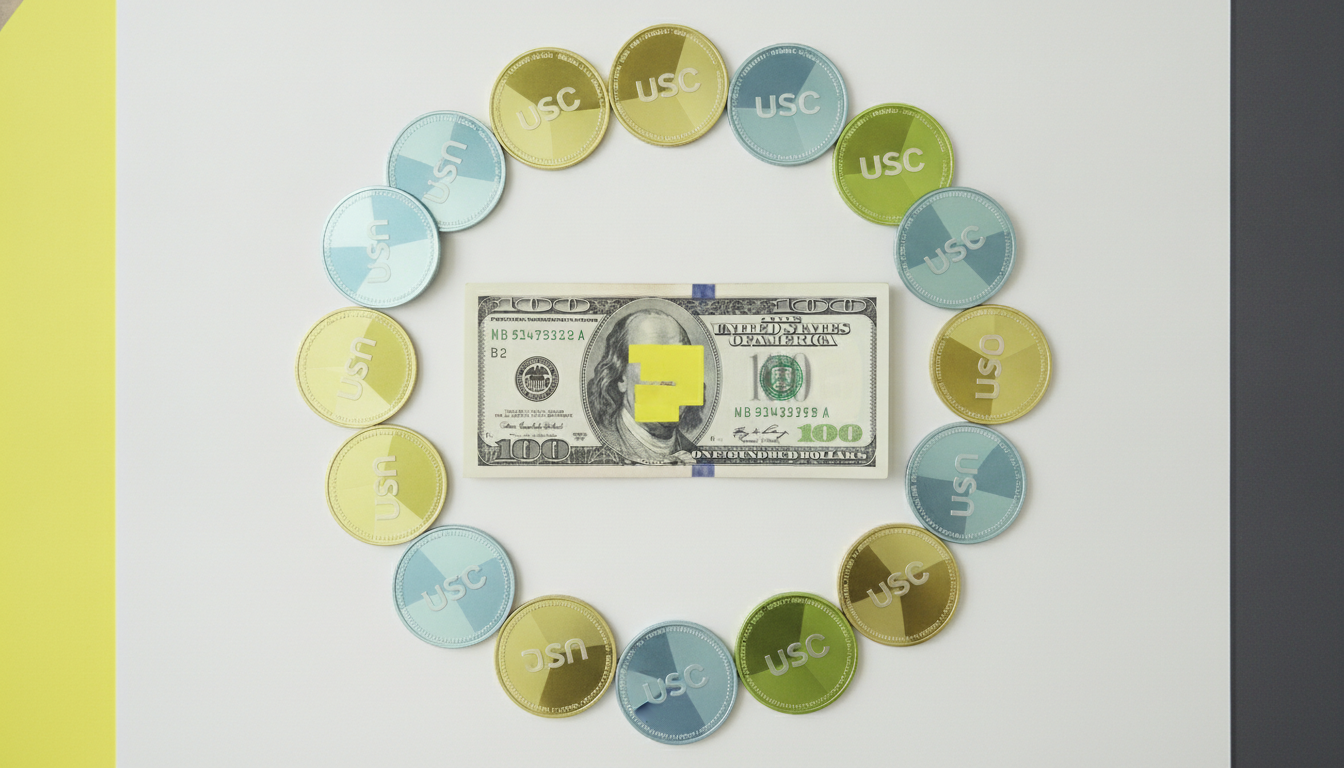
USDC invoices tend to get paid faster because they remove bank timing risk and reduce friction at checkout. When funds can settle in near real time, clients pay when they approve the invoice instead of waiting for the next banking day. Bluevine found that invoices with embedded pay-now options are paid about 174% faster (seven days vs. 18 days), illustrating how faster rails close the gap between approval and funds received. Using USDC gives you that instant-rail behavior without card fees eating into margin. This is a direct way to get paid faster with stablecoins while keeping your price list in USD. (bluevine.com)
Lower fees are another win. Card acceptance often costs 1.5% to 3.5% plus a small fixed fee, and swipe fees hit a record 2.35% average in 2024–2025, squeezing small merchants hardest. ACH is cheaper per transfer, but it still takes one to three business days and remains subject to cutoffs and reversals. On low-fee blockchains such as Solana, a USDC transfer’s base fee is measured in lamports (tiny fractions of SOL), typically well under a cent per transaction. For small invoices, that is a serious difference. (capitalone.com)
Transparency and traceability matter, too. Every USDC payment leaves a public record, which means you can confirm receipt and timestamp without waiting for a processor dashboard to update. If a client claims “we sent it,” you can verify on-chain in seconds. And if you ever need to demonstrate payment history to an auditor or a partner, you have cryptographic receipts by default. As Circle puts it, USDC is intended for always-on settlement with visible reserves and reporting that strengthen trust in a $1 value. (circle.com)
Here’s how the numbers compare in typical cases:
| Payment Method | Transaction Fee | Processing Time |
|---|---|---|
| USDC (e.g., on Solana) | Often <$0.01 per transfer (base fee 5,000 lamports/signature plus optional priority) | Seconds to under a minute for same-chain transfers |
| ACH | ~$0.20–$1.50 per transaction (business pricing varies) | 1–3 business days; same-day windows exist with limits |
| Wire (domestic) | ~$25–$35 outgoing (bank-dependent) | Same day if before cutoff |
| Credit/Debit Card | ~1.5%–3.5% + $0.20–$0.30 | Authorization instant; funding typically T+1 to T+3 |
Sources: Solana documentation on base fees; NACHA on settlement windows and limits; NerdWallet/Corpay on bank wire pricing; Capital One on card fee ranges and business sources on typical settlement timelines. (solana.com)
Two security upsides stand out for finance teams. First, USDC’s reserve disclosures and AICPA-standard attestations reduce ambiguity about backing. Second, on-chain tooling helps you whitelist client addresses, set invoice-specific payment links, and monitor confirmations in real time. As Christian Catalini of MIT’s Cryptoeconomics Lab notes, stablecoins are interoperable, programmable money that can “rewire the global financial system,” which, at the business level, means invoices that settle faster and more predictably. (circle.com)
Some platforms already package these gains into simple workflows. For example, the SeevCash App lets freelancers generate dollar-denominated invoices that accept USDC alongside traditional methods, then track confirmations without juggling multiple dashboards. It is one path among many, but the goal is the same, fewer clicks for clients and quicker settlement for you. (For term-setting tactics that pair well with fast rails, see our guide to Net 15 vs. Net 30.) (developers.circle.com)
Before moving on, a quick reality check. You still need clear references on the invoice so accounting can match payments. The difference is you will wait minutes, not days, for those references to show up with the funds. That is what turns “approved” into “paid.”
How do you set up USDC invoicing without making it complicated?

Set up USDC invoicing by choosing a primary network, selecting a business-ready wallet or invoicing platform, and updating your invoice template to include token, network, and address. Then add a payment link or QR code that drops clients into the right token on the right chain, with a unique reference in the memo. With that, most clients can pay in one step, and you see the confirmation almost immediately on-chain. The rest is good hygiene, reconcile by reference ID, record the USD amount on the invoice date, and document the chain used. (developers.circle.com)
Here’s a practical path you can follow today:
-
Pick your chain and standardize. Choose a network where clients already hold balances or that offers very low fees, such as Solana for speed and cost or Base for EVM familiarity. Decide on one primary chain for invoices to minimize confusion. Document it. Circle lists supported chains, and many invoicing tools default to a stable set like Ethereum, Base, and Solana. (circle.com)
-
Choose a wallet or invoicing tool. If you are already using a crypto-capable invoice generator, enable USDC as a payment option and test a small invoice to yourself. If you need a purpose-built solution, consider platforms that generate payment links, QR codes, and reconcile by memo or reference number. Coinbase Commerce and similar services can issue crypto invoices, and business-focused platforms increasingly support USDC natively. The key is matching each invoice to a unique on-chain reference. (circle.com)
-
Update your template. Add a “Stablecoin Payment” box to every invoice, “Pay in USDC on [Network], to [Address].” Include a QR code, a memo or reference (for example, “INV-1045”), due date, and your late-fee policy. If you rely on recurring revenue, pair this with automated retries and dunning best practices to keep collections tight. See our playbook on recurring subscriptions with stablecoins for tips on renewals and retries. (theblock.co)
-
Write clear USDC invoice instructions for clients. Spell out three fields in plain English, Token (USDC), Network (for example, Solana), Address (copyable or scannable). Add one line about sending from the same chain and verifying the token contract if they are using a multi-chain wallet. That short paragraph prevents most mis-sends.
-
Add a fallback. Give clients an alternate method for edge cases (ACH or card) so an accounts payable team with rigid controls is not blocked. Your invoice should present USDC first, then list legacy routes second.
-
Reconcile smartly. Record the USD amount on the invoice date, not the block timestamp, and attach the transaction hash in your accounting system. If you use a crypto-aware AR tool, it should match the memo or reference automatically.
-
Decide how you will hold funds. Some teams hold USDC as treasury for vendor payables or stable yield products; others convert to cash through an exchange or provider. Document your policy for audit trail and tax prep. If you anticipate routine conversions or payouts to bank accounts, select a provider that offers managed settlement flows. (developers.circle.com)
“Here is how this actually works.” A design studio invoices $4,200 for a sprint. Before, the client approves on Thursday, ACH starts Friday afternoon, funds post Tuesday or Wednesday because of weekend gaps. After, the invoice carries a USDC payment link on Solana. The client pays Friday at 5:12 p.m., the studio sees on-chain confirmation immediately and marks the project funded. Same dollar amount. Fewer days idle. Better planning. NACHA notes most ACH now settles in one day or less, but cutoff times and return windows still complicate the last mile. USDC avoids those bottlenecks. (nacha.org)
💡 Pro Tip: Consider invoicing software that integrates directly with USDC to streamline your payment process. Embedded stablecoin support means fewer manual steps, automatic memo matching, and clearer audit trails, which translate to faster approvals and fewer “where did this payment come from?” emails.
A word on fees and speed for your chosen chain, on Solana, the base transaction fee is 5,000 lamports per signature, with optional priority fees if you want to speed inclusion under heavy load. That keeps typical USDC transfers under a cent, while still giving you the option to bump priority when it matters. Cross-chain moves have also become faster, Circle’s updates reduced many flows from minutes to seconds. (solana.com)
What concerns should you address before switching clients to USDC invoices?
You will hear three objections, “Isn’t crypto volatile?”, “Is this legal and compliant?”, and “Won’t this confuse my clients?” USDC addresses the first with reserves and a $1 target value, Circle publishes monthly reports with AICPA-standard attestations, and major payment firms have used USDC in settlement pilots. On compliance, U.S. policymakers have advanced proposals for a federal framework for payment stablecoins that emphasize 1:1 reserves and disclosures for permitted issuers. Finally, client confusion fades when your invoice shows Token, Network, and Address in one box, plus a QR code. Keep it that simple. (circle.com)
Misconceptions linger because “crypto” is a big tent. You are not asking a client to trade volatile assets; you are offering a dollar-denominated rail that works after hours. A helpful framing is Jeremy Allaire’s testimony to Congress, USDC is helping pave the way for digital dollars to be the leading currency of the internet. For invoicing, that translates to fewer late checks, shorter cash conversion cycles, and cleaner records. See the difference? (democrats-financialservices.house.gov)
Risk always deserves a plan. Address operational risk (wrong chain or address) by fixing one network as your default and printing it on every invoice. Address custody risk by using reputable wallets or an invoicing tool with address whitelisting. Address counterparty risk by working with clients who agree to on-chain payments in the contract. And address fraud risk with standard controls, dual-approval before changing pay-to details, plus a test payment for new clients. If you need a controls refresher, our guide on reducing failed payments and fraud in crypto invoicing covers common traps and how to avoid them. (theblock.co)
Legal and tax checkpoints exist, and you should acknowledge them once. In the U.S., FinCEN’s 2019 guidance explains how anti-money-laundering rules apply to virtual currency businesses, and the IRS treats virtual currency as property for tax purposes, which affects accounting and reporting. New York’s DFS also issued guidance on USD-backed stablecoins for regulated entities. If your business model touches custody or exchange services, get counsel. For straightforward invoicing, align your documentation and keep clean records. (fincen.gov)
A final concern is “Will clients pay?” That is mostly a design problem. People pay faster when you remove effort. Present USDC first with a one-click link or QR, then show legacy methods as backup. Bluevine’s survey shows frictionless “pay now” buttons shave days off collections. If you have struggled with slow Net 30 cycles, check our guide on payment terms and cash flow strategy. Pairing tighter terms with faster rails closes the loop. (bluevine.com)
What are the next steps and where can you go for help?
Start today by updating one invoice template. Add a Stablecoin Payment box with Token (USDC), Network (your default), and Address. Generate a payment link and QR, then send a $10 test invoice to yourself from a separate wallet to verify the flow, memo matching, and confirmations. Tell your next client you support USDC and include two lines of how to pay instructions. That is enough to cut days off your receivables. (developers.circle.com)
To go deeper, study three areas. First, automation, use an invoicing tool that triggers reminders when due dates approach and logs on-chain confirmations in your AR ledger. Businesses using smarter reminder timing get paid faster, and that is before switching rails. Second, recurring revenue, if you have subscriptions, pick a tool that can pull stablecoin payments or generate dynamic pay links per cycle with dunning. Third, risk controls, set approval rules for changing addresses, and test every new client with a micro-payment. Our resources on recurring subscriptions, modern invoicing flows, and fraud prevention walk through these patterns. (charlotteobserver.com)
Communities and official primers help shorten the learning curve. Read Circle’s USDC guides for chain-specific tips and developer docs if you are integrating payment links into custom software. Keep an eye on Federal Reserve and NACHA updates to understand where instant rails like FedNow and same-day ACH fit next to your USDC flow. Stablecoins will not replace every method overnight, but they are excellent at shrinking the invoice approval-to-funds window. (developers.circle.com)
If you want a productized path with guardrails, SeevCash Plus offers advanced features for teams that need roles, approvals, and built-in memo matching, all while keeping USDC payments simple for clients. It is one of several options, and the right choice is the one that reduces friction for your buyers and shortens your cash cycle.
For more hands-on tactics, we have published guides that pair well with USDC invoicing:
- Set smarter terms with Payment Terms (Net 15 vs Net 30) and Cash Flow Strategy for Freelancers
- Build a reliable flow from quote to cash with Modern Invoicing for Global Freelancers and SaaS: From Quote to Cash
- Use a checklist from Crypto Invoice Generator: What to Include and How to Send
- Prevent headaches with Reduce Failed Payments and Fraud in Crypto Invoicing
- If you run subscriptions, see Recurring Subscriptions with Stablecoins: Setup and Dunning Best Practices
- For a broader overview, skim Stablecoins for Business: What They Are, How They Work, and When to Use Them
Common Questions About Invoicing in USDC
Is USDC safe to use for invoicing?
USDC is designed to hold a stable value near $1 and is backed by cash and short-duration U.S. Treasuries, with monthly reserve reporting. That design reduces volatility risk compared with other cryptocurrencies. Safety also depends on your practices, use trusted wallets, print the exact network and address on invoices, and verify first-time payments with a small test. Circle’s transparency page explains reserves and attestations that underpin the $1 target. (circle.com)
How do I convert USDC to cash?
If you need banked dollars, you can use a regulated exchange or a payments provider that supports converting USDC to fiat and depositing to your account. Some providers offer managed settlement that converts incoming USDC and pays out in USD on a schedule. Choose a platform that fits your geography, compliance needs, and timing expectations. Circle’s documentation describes managed pay-ins and payouts many businesses use behind the scenes. (developers.circle.com)
Are there any fees associated with USDC transactions?
Yes, but they are usually small and depend on the network. On Solana, a transfer includes a base fee of 5,000 lamports per signature (a fraction of a cent), with an optional priority fee for faster inclusion during peak demand. On Ethereum mainnet, fees vary with gas. Many teams standardize on a low-fee chain for invoices to keep costs negligible. (solana.com)
Can I invoice clients who are not familiar with cryptocurrencies?
Yes. Treat USDC like a pay now option denominated in dollars. Add a short instructions box, Token (USDC), Network (your default), Address (QR plus copy). Clients click, approve, and you see funds settle quickly. Bluevine’s data shows that clear, low-friction payment options get invoices paid much faster, which is exactly the outcome you want. (bluevine.com)
Take your first step today
Do this today, duplicate your main invoice template and add a Stablecoin Payment box with Token = USDC, Network = [your default], and your address as both text and QR. Send yourself a $10 test invoice, verify the on-chain confirmation, and note the transaction hash in your records. Then offer this option to your next client with a single sentence in the email, “You can pay in USDC for same-day settlement.” This small shift lets you invoice clients with USDC and shorten your cash cycle without changing your pricing.
As Christian Catalini of MIT puts it, stablecoins are programmable money that can reshape how payments work. Your invoices are where that meets reality, faster settlement, fewer delays, and more control over cash flow. (crowdfundinsider.com)
If you want structured help, try a USDC-ready invoicing platform and compare the time-to-cash on your next three invoices. When you see the gap close from days to minutes, you will know the switch was worth it.