

SeevCash Plus Features: Advanced Controls for Finance Teams

SeevCash Plus Features: Advanced Controls for Finance Teams
The short answer: the features in SeevCash Plus give finance teams tighter control, sharper visibility, and faster decisions by combining granular approvals, policy automation, real‑time cash views, and audit‑ready records. The result is fewer manual steps, cleaner data, and quicker closes that hold up under scrutiny. That changes how teams plan, approve, and pay.
More than half of finance leaders say they missed a time‑sensitive move because data arrived too late, a visibility gap with real cost. According to CFO.com’s coverage of a recent Intuit survey, 57% reported lost opportunities tied to delayed financial information, while another study found only 2% of leaders have complete confidence in cash flow visibility. Controls without clarity are theater. Clarity without controls invites risk. Your team needs both. Sources worth a look: CFO.com’s summary of the Intuit mid‑market report and BlackLine’s global data confidence survey. (cfo.com)
What problems are holding finance teams back today?
If your team feels stretched, you are not imagining it. The most common blockers fall into three buckets that compound each other. First, data fragmentation across ERP, banks, payroll, and cards. Second, approvals and policies that live in email threads and spreadsheets. Third, audit evidence that is hard to assemble under pressure. More than half of leaders admit late or incomplete data has cost them real decisions in the last six months, and industry surveys continue to show low confidence in cash visibility. Payments fraud remains elevated too, especially on checks. Each issue clips your decision speed and raises the odds of compliance headaches or outright loss. Multiple benchmarks confirm the pattern: opportunity costs from delayed data, weak visibility into cash, and rising fraud attempts against business payments. Address those three, and everything else gets easier. (cfo.com)
Finance teams know this in their bones. Close week arrives, journals are open, and reconciliation crawls. Someone chases a vendor’s new bank details, someone else copies a cash forecast into a slide. A director asks for scenario B in 30 minutes. The team buys time with manual checks. Risk rises in the cracks.
Poor visibility distorts decisions. If cash positions update only once a day or approvals sit in limbo, forecasting becomes guesswork. The cost shows up as missed early‑pay discounts, excess idle balances, or drawdowns you could have avoided. It also shows up as fraud exposure. The Association for Financial Professionals reports that 79% of organizations faced payments fraud attempts in 2024, with checks still the top attack surface. That should prompt a rethink of pre‑payment controls and vendor changes. (afponline.org)
Manual work steals time from analysis. McKinsey’s research shows that currently available technology can fully automate roughly four in ten finance activities and mostly automate another fifth. Data collection, reconciliation, and rule‑based validations are prime candidates. When those steps remain manual, your analysts become human routers, not advisors. (mckinsey.com)
Cycle time matters. APQC finds that top performers close faster and with fewer restatements, while median annual close still stretches to multiple weeks. The close is where weak controls and data quality hide. If your month‑end is slow, your mid‑month decisions are stale. (apqc.org)
The good news? The fixes are specific. You do not need a new philosophy of finance. You need enterprise controls that travel with the transaction, policies that run as rules, and a live view of money that is trusted by CFO, controller, and audit.
How do advanced features change that for finance teams?

The right set of controls and visibility tools reduces approval guesswork, shortens reconciliation, and makes audits dull in the best possible way. The building blocks are consistent across companies: granular approval paths by role and amount, policy logic that runs before spend is committed, real‑time cash views, vendor and beneficiary verification, and complete, time‑stamped trails. Put them together, and two shifts happen. First, decisions move to the start of the process, not the end. Second, data lands ready for reporting. That is how you cut errors and days, not just clicks. Gartner’s finance research echoes this push toward governed analytics and AI‑assisted controls to support faster, higher quality planning. (gartner.com)
At SeevCash, we built these capabilities so controllers can set spend guardrails that actually hold in the wild. Our approach centers on approvals that reflect real authority, cash positions that update as money moves, and audit evidence that writes itself while work happens. If your team is moving from bank wires to digital rails, you might find our migration plan helpful too. It covers risk checks, roles, and dual controls you can adopt in stages. See how we recommend phasing changes in Migrate from Bank Wires to Stablecoins: A Practical Migration Plan.
Add one more point. Visibility only matters if the underlying data is trusted. As Owen Ryan, co‑CEO at BlackLine, puts it, “Trusting the data organizations work with is critical for effective decision‑making, not only for the Office of the CFO but for the entire business ecosystem.” We agree, and we designed our records to make that trust testable. (blackline.com)
Which features deliver the most control and visibility?
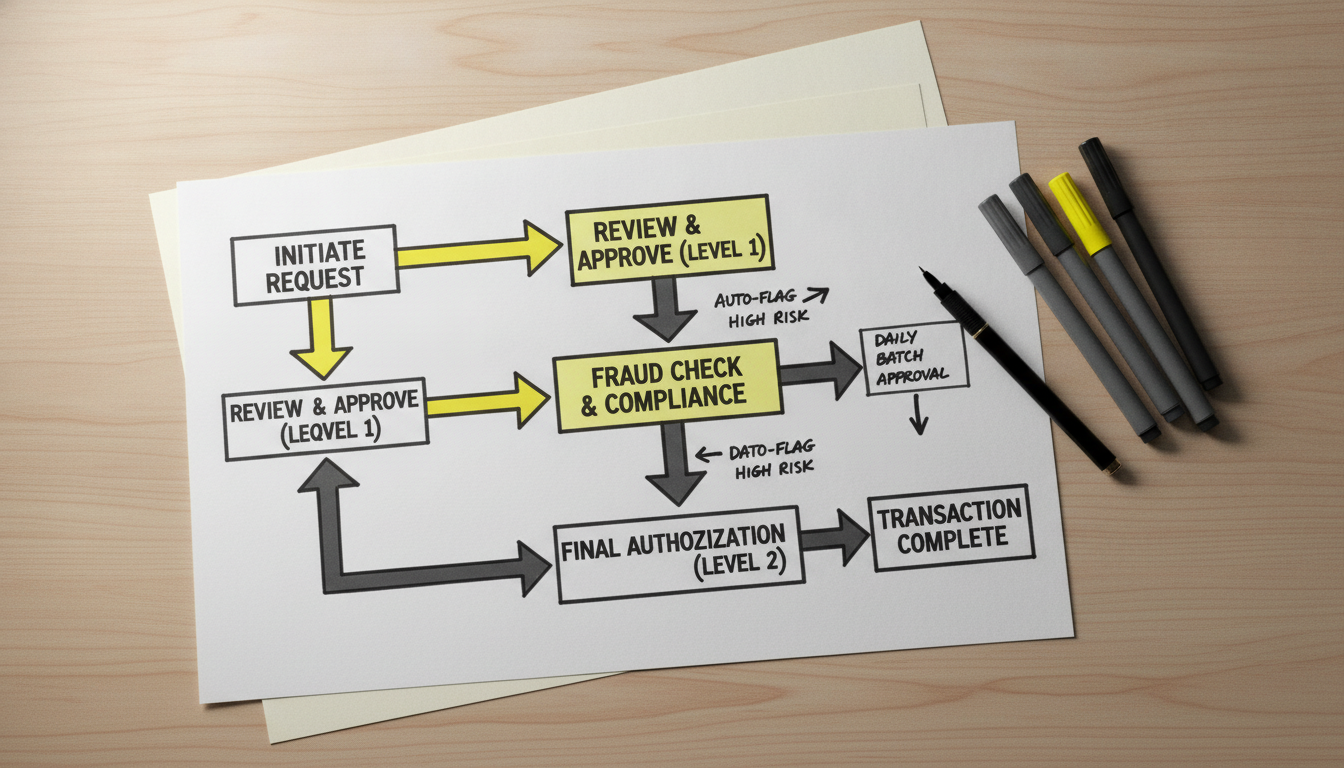
The features that matter share a common thread. They make the right choice the default choice. Here is the short list that consistently moves needles for mid to large teams. Each one ties to a concrete outcome: faster closes, fewer exceptions, and cleaner audits. Industry research on automation’s potential, fraud rates, and AP costs backs the gains that disciplined controls can unlock. Start with approvals that match authority, add pre‑payment checks, keep your cash view live, and capture the why behind every transaction. That is the formula for fewer surprises and better calls in leadership reviews. (mckinsey.com)
Role authority and spend paths
Approvals should fit roles and risk. With role based approvals in SeevCash Plus, finance sets multi‑step paths by amount, cost center, vendor risk, or currency, then applies exceptions for urgent but capped spends. That keeps power with accountable owners while reducing slack time. The result is less back and forth, fewer overruns, and a trail that shows who decided and why. See the pattern?
Policy as rules, not PDFs
Expense and payment policies often live as static documents. Turn them into active checks. For example, block first‑time vendor payouts above a threshold until bank details are re‑verified, or require an extra approver for international payouts. AFP data shows payments fraud is still widespread, especially on checks. Pre‑payment rules blunt that risk where it starts. (afponline.org)
Live cash positions and short‑horizon forecasts
Cash that updates with every movement is different from a daily snapshot. It changes treasury’s posture. Leaders see what is funded and what is pending, not just what posted yesterday. BlackLine’s survey implies confidence in cash flow visibility remains very low. A live view is the antidote. (blackline.com)
Vendor and beneficiary verification
Treat vendor onboarding and bank updates like security events. Verify sources, match names, and time‑box any exceptions. Payment change requests need out‑of‑band confirmation. Small steps, big lift. AFP’s findings on persistent fraud pressure make this non‑negotiable. (afponline.org)
Multi‑entity and multi‑currency hygiene
Growth complicates everything. When teams span entities and currencies, use SeevCash enterprise controls that keep local autonomy while preserving global rules. That includes currency locks at approval, consistent categorization, and clear intercompany lanes. If you are exploring digital assets for settlement, orient your policies first. This guide is a solid primer: Stablecoins for Business: What They Are, How They Work, and When to Use Them.
Integration that respects your stack
Controls fail when they live off to the side. Finance needs integration to ERP, HRIS, banks, and modern payment rails. Two points matter. First, post the right thing, once, to the ledger. Second, keep human approvals and system events in the same audit record. Gartner’s finance analytics guidance stresses governed data and AI‑assisted validation workflows, which align with this approach. (gartner.com)
Close and audit, by design
Do not bolt audits on at the end. Capture approvals, comments, and evidence at the moment of decision. APQC’s work on close cycle times shows that faster closes correlate with fewer after‑the‑fact surprises. When your evidence writes itself, your auditors spend more time confirming than chasing. (apqc.org)
What does this look like in practice?
Before: approvals in email chains, vendor changes accepted on faith, cash forecast rebuilt weekly from bank portals and spreadsheets. After: risk‑based approval paths, bank detail checks before first payments, live cash positions, and one trail that shows every step.
Curious how this meets crypto‑specific workflows like contractor payouts? Our playbook covers scheduling, policies, and approvals you can map to your chart of accounts, then reconcile cleanly. You can review it here: Set Up Contractor Payroll with SeevCash: Policies, Schedules, and Approvals and Crypto Payroll for Remote Teams: A Practical Playbook.
Integration capabilities with existing systems
Here is how connection typically works. Data enters through your ERP or HRIS, vendor master syncs nightly, and bank files or API webhooks update cash in near real time. Approvals sit on top of that data with role and risk logic. Once approved, entries hit the ledger with the right tags, and the audit log captures users, timestamps, and policy checks. See the difference?
Comparison: controls that travel with the transaction
| Feature | SeevCash Plus | Traditional Tools | Benefits |
|---|---|---|---|
| Approvals by role, amount, and risk | Multi‑step, policy‑driven paths with exceptions and expiry | Email threads and static sign‑off lists | Faster cycle time, clearer accountability |
| Pre‑payment vendor checks | Built‑in bank detail verification and change holds | Manual callbacks and ad hoc checks | Lower fraud exposure, fewer errors |
| Live cash view | Positions update as money moves | Daily or weekly snapshots | Better funding decisions, real agility |
| Policy as rules | Configurable controls run before commit | PDFs and manuals after the fact | Fewer violations, cleaner data |
| Audit trail | One record that binds approvals and postings | Evidence assembled at period end | Faster audits, lower prep time |
| Multi‑entity standards | Global rules with local autonomy | Inconsistent practices by entity | Comparable reports, less rework |
According to Ardent Partners, average invoice processing still costs into the double digits for many teams, with best performers a fraction of that. Redirecting effort from manual steps to policy‑driven approvals and straight‑through posting is where those savings come from. McKinsey’s estimates on automatable finance work echo the same leverage point. (bottomline.com)
🔑 Key Takeaway: SeevCash Plus offers tailored capabilities that enhance visibility and control for finance teams.
Compliance note, once: your controls should align with internal policies and applicable accounting standards, payments rules, and local regulations. Document changes, keep approvals current, and train approvers when policies update. For a deeper look at our security posture, we publish the details in SeevCash Security and Compliance: How We Protect Your Business.
If you are setting up from scratch, our quick start guide for sending your first digital invoice can help your AP and AR teams experiment without retooling the ledger on day one. Here is a step‑by‑step walkthrough: How to Set Up a SeevCash Account and Send Your First USDC Invoice and The Complete Guide to Accepting Crypto and Stablecoin Payments for Startups and Remote Teams.
What results do finance teams see after adopting these controls?
Controls and visibility pay off in three predictable places. First, cycle time falls. When rules run before spend, fewer exceptions show up at close. Second, fraud exposure drops, especially for check‑heavy flows, because vendor changes and first‑time payments get extra scrutiny. Third, teams spend more time on analysis. Industry research supports these shifts. Ardent Partners’ AP studies continue to show that high‑automation teams bring invoice costs down significantly compared with manual peers. AFP’s surveys confirm persistent fraud attempts, reinforcing the case for pre‑payment checks. APQC’s benchmarks link faster closes to better period‑end quality. Those are the wins that show up in your dashboards and your audit letters. (bottomline.com)
A U.S. software company with 500 employees faced late approvals and surprise cash gaps. Before, managers approved in email, vendor updates sailed through, and treasury stitched cash positions from daily bank exports. After a staged rollout of risk‑based approvals and live cash views, finance cut approval cycle time on high‑value bills, reduced exceptions at close, and avoided two costly drawdowns by seeing pending outflows in time to plan.
A multi‑entity marketplace operating across three regions struggled with inconsistent rules. Regional controllers applied different approval levels, and intercompany charges generated reconciliations that dragged. With one set of SeevCash enterprise controls and entity‑aware policies, they reduced manual corrections and made global reports comparable without off‑system notes. The effect was less time spent arguing definitions and more time deciding actions.
A distributed contractor workforce had growing exposure to bank detail fraud. The team added first‑payment checks and extra approval steps for bank changes. Result: cleaner vendor master, fewer holds at pay run, and auditors who could follow the logic without hunting for artifacts. AFP’s data on fraud attempts shows why this approach works. The attack surface shrinks when rules harden the riskiest transitions. (afponline.org)
There is also a morale dividend. When approvals are clear and evidence is automatic, analysts get hours back. McKinsey’s view that a large slice of finance activity is automatable is not an indictment of the team. It is permission to move your best people to planning and partnership. They can dig into margins and customer health instead of reconciling column G. (mckinsey.com)
Bridge to what you can do next: pick one process with frequent exceptions, like vendor onboarding or capital purchases. Move a single policy into rules and set an approval path by role and amount. Give it two weeks. Measure the exception rate and the time to approve. Expect a visible shift.
Common Questions About SeevCash Plus Features
How does SeevCash Plus integrate with existing financial systems?
Integration should not mean reinvention. Our design connects to your ERP and HRIS for master data, ingests bank activity by file or API, and posts approved entries once with the right tags. Approvals and policy checks ride along with the transaction, so your audit trail contains both human decisions and system events. Teams typically start with vendor and payment flows, then add expenses and treasury. For many, the first quick win is mapping cost centers and roles to approval paths while keeping the ledger intact. That way, analysts work from one source of truth and leaders see live positions without waiting for a daily export. Gartner’s finance analytics research points the same direction, stressing governed data and AI‑assisted validation to keep decisions fast and reliable. (gartner.com)
What specific challenges can SeevCash Plus help address?
Three stand out. First, low visibility into cash and commitments, which delays or distorts decisions. BlackLine’s global survey highlights low confidence in cash flow visibility, and CFO.com reports missed opportunities tied to delayed data. Second, payments risk, especially with first‑time vendor payouts or bank detail changes. AFP’s surveys show continued fraud pressure. Third, slow closes that mask errors until the last mile. APQC’s close benchmarks illustrate the spread between top performers and the median. Our enterprise controls target each pain directly by pushing rules and approvals to the front, keeping cash live, and capturing evidence as work happens. (blackline.com)
Are there any case studies demonstrating its effectiveness?
Yes. Teams adopting enterprise controls like role‑aware approvals, pre‑payment checks, and live cash positions report shorter cycle times and cleaner audits. The direction aligns with independent research. Ardent Partners shows that high‑automation AP teams process invoices at a fraction of manual costs, and McKinsey estimates that roughly 40% of finance activity can be fully automated today. We share anonymized outcomes during discovery so you can compare against peers with similar systems and scale. (bottomline.com)
What kind of support do we provide during implementation?
We guide your team through policy design, role mapping, and data connections. The work starts with a short workshop to translate your current approvals and policies into rules. Then we phase integrations to avoid ledger risk. Training focuses on approvers and controllers first, not just admins, so decisions improve on day one. For security and compliance questions, we publish detailed controls and undergo external reviews. You can read more about our approach here: SeevCash Security and Compliance: How We Protect Your Business.
What are the new features of GCash?
GCash continues to expand its financial services beyond payments. Recent additions include GCrypto for buying and selling digital assets within the app, GInsure as an in‑app insurance marketplace, and GStocks Global, which allows eligible users to buy and sell global securities through a partner brokerage. GCash has also promoted new security steps such as in‑app authentication, with ongoing updates via its help center. These features target retail consumers rather than corporate finance teams, but they show how mobile platforms are broadening financial access. Sources: GCash Help Center pages for GCrypto and GInsure, and GStocks Global terms. (help.gcash.com)
What are the features of Cash App?
Cash App focuses on consumer and small business money movement. Core features include person‑to‑person payments, a customizable Visa debit card, direct deposit, savings, stock investing with no commissions, and bitcoin buying. Families can set teen accounts with sponsor controls. For merchants, Cash App Pay enables checkout by QR or in‑app authorization. These are powerful for individuals and micro‑merchants, though they are not a substitute for enterprise‑grade approvals and audit evidence. Sources: Cash App learning hub, App Store listing, and developer docs. (cash.app)
That is the landscape. If you are weighing SeevCash enterprise controls against consumer wallets, the question is not which is flashier. It is which one makes your auditors yawn and your board nod.
Now, take one concrete step today. Pick a single high‑impact rule, like holding first‑time vendor payouts over a set threshold for an extra approver, and turn it on for a two‑week pilot. Track approval time, exception rate, and any blocked risks. Want a template for that workshop? We share one when you reach out.
If you are ready to see actual workflows, set up a sandbox through the SeevCash App, map two approval paths, and connect a non‑production bank feed. Then run a dry‑run close with your top five policies active. We will walk with you through the setup, answer questions about data flow and evidence, and leave you with a checklist you can reuse on the next rollout. For teams exploring stablecoin settlement in parallel, use the migration guide to draft your phased plan, then compare outcomes after thirty days. Links to both are above.