

Late Fees Policy Template for Freelance Invoices

Late Fees Policy Template for Freelance Invoices
A template for a late‑fee policy on freelance invoices should spell out when payment is due, the grace period, the late payment fee clause (flat or percentage), how interest accrues, when reminders go out, and what happens if nonpayment continues. Keep it simple, display it on every invoice, and ensure it complies with local law. If you already use a freelance invoice terms template, incorporate these terms there so clients see them upfront.
Payment is due. The due date passes. Silence. You follow up. Another week slips by. Rent is due, and your project pipeline stalls because cash is stuck in limbo. Late payments don’t only drain your bank account. They chip away at your professionalism. A clear invoice late fee policy fixes that.
Freelancers often fear that adding late fees will scare clients off. My recommendation? Treat your policy as a standard business boundary, not a threat. Companies you want to work with respect clarity. And yes, a well‑written policy helps you get paid faster.
Across small business data sets, late payments remain common despite some recent improvement. FreeAgent reported that 49.3% of UK invoices were paid late between June 2023 and June 2024, underscoring how widespread the problem is. That is real money sitting on someone else’s balance sheet, not yours. (freeagent.com)
Importance of Late Fees
A late‑fee policy protects your cash flow, signals professionalism, and nudges behavior in your favor. Late payment is not rare; it’s routine. Xero’s Small Business Insights note ongoing challenges with “late payment durations,” even when overall payment times nudge better. A visible clause, clearly written into your terms, creates an expectation that deadlines matter. Pair it with polite, scheduled reminders and you’ll reduce the gray zone between “almost paid” and “still waiting.” Behavioral research also backs this up: people are more motivated to avoid a loss than to pursue an equivalent gain, a principle known as loss aversion, which is why stated penalties often drive earlier action. (xero.com)
Cash flow is the nervous system of a freelance business. Late money isn’t just late; it changes what you can say “yes” to next month. Consider two designers with identical client lists. One has a clear policy template for late fees and routine reminders. The other relies on goodwill. The first has predictable receivables and can plan software purchases and subcontractor time. The second keeps triaging which bill to pay first.
Here’s how the psychology helps you. When your terms state, “Payments after 15 days incur a $25 fee plus 1% per month,” it turns a vague preference into a sharp consequence. In behavioral terms, you anchor expectations and frame the cost of delay as a potential loss. Kahneman and Tversky’s prospect theory shows we pay more attention to losses than to equivalent gains, so clients often choose to avoid the fee and pay on time. See the difference? (ucl.ac.uk)
That “sharpen the edge” effect is not abstract. In a recent Xero media release, North America Managing Director Ben Richmond highlighted that even as payment times improve, late payment durations continue to bite, which “underscores the ongoing challenges faced by small businesses.” Short quote, big lesson: improvements aren’t automatic, and policies help you close the gap. (xero.com)
Another reason late fees matter: they communicate that you run a business, not a hobby. Clients follow the tone you set. If your terms are precise, you get treated accordingly. I’ve seen this pattern before: the freelancers with the crispest invoice language are the ones who spend less time chasing money and more time serving clients.
Analogy time. Think of a due date without a fee like a speed limit without a ticket. People know the rule but some will bend it until there’s a consequence. The point isn’t to “punish” clients. It’s to turn a courtesy into a standard.
What does this mean for you? Establish the rule, state it consistently, and apply it fairly. You’ll reduce delays, avoid awkward back‑and‑forth, and safeguard your most limited resource: working time.
💡 Pro Tip: Consider using a friendly reminder system before applying late fees. A schedule like “3 days before due, on the due date, 3 days after, 10 days after” keeps things polite and predictable, and it catches the honest oversights that cause many delays.
Components of a Late Fees Policy
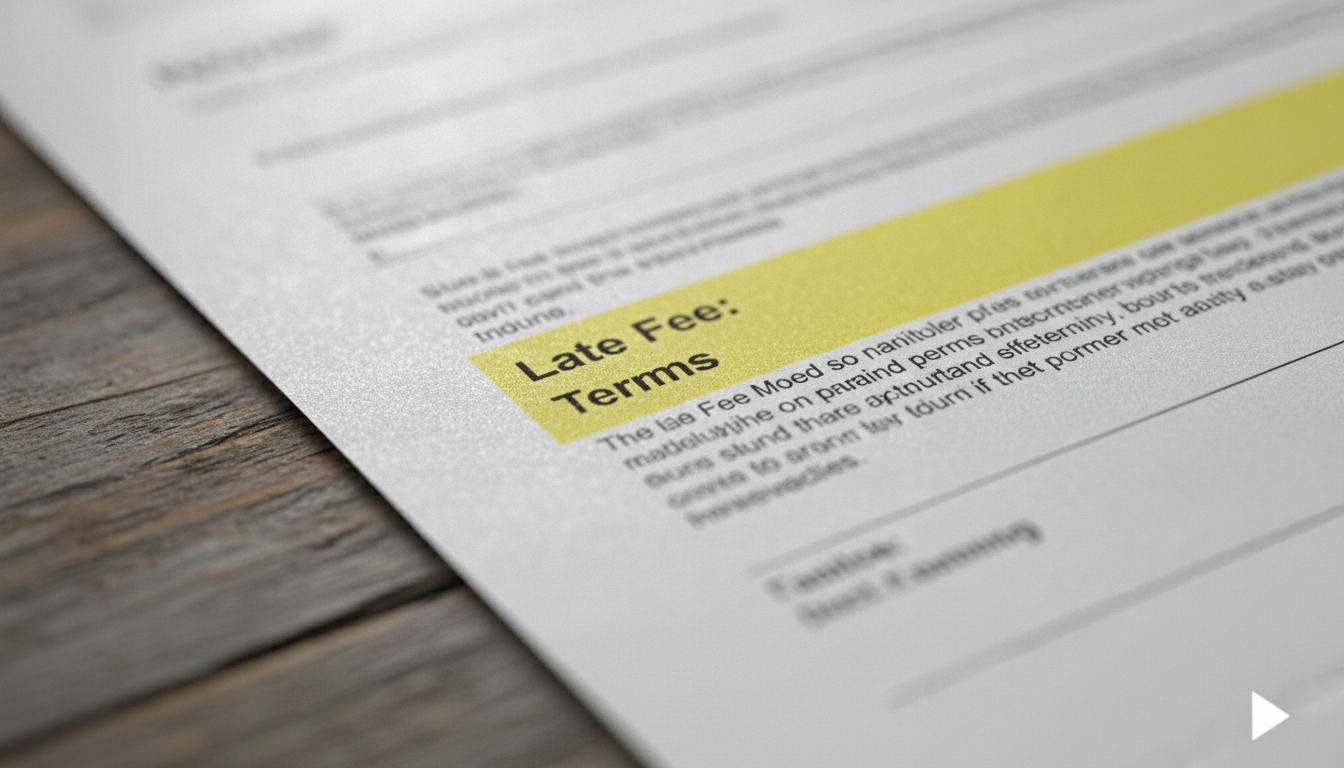
A complete late‑fees policy tells clients exactly what will happen, when, and by how much. Start with plain‑English payment terms, a grace period, the specific late payment fee clause (flat fee, percentage, or hybrid), how interest compounds (if at all), and escalation steps if the account remains overdue. Use your freelance invoice terms template to put this in writing on every invoice and contract. For many freelancers, a fixed fee on small projects and a percentage on larger invoices provides a fair balance. The key is clarity: list the trigger date, the exact fee, and how often it repeats, then remind clients gently before it applies. (legalclarity.org)
First, define the due date and grace period. “Net 15” or “Net 30” are common, but the label alone isn’t enough. Spell out the calendar date on the invoice to remove ambiguity and use consistent language across jobs. If you aren’t sure which payment term fits your cash flow, see our guidance on choosing between shorter and longer terms in Payment Terms (Net 15 vs Net 30) and Cash Flow Strategy for Freelancers.
Second, choose your fee structure. Flat fees are easy to understand for smaller invoices. Percentage fees scale better for larger balances, often in the range of 1% to 1.5% per month, where permitted by law. Hybrid models set a modest flat fee plus a small monthly percentage for balances that drag. Note that enforceability usually depends on stating your terms before work begins and placing the late payment fee clause in both the agreement and the invoice. (legalclarity.org)
Third, explain whether interest compounds. Some freelancers keep it simple by applying the percentage to the original overdue balance each month. Others compound on the outstanding amount. If you choose compounding, state it directly.
Fourth, set escalation steps. After a defined period (for example, 45 or 60 days), pause work, and after 90 days consider formal collection steps as a last resort. Spell this out calmly, not as a threat.
Here’s a quick comparison of common late fee structures:
| Fee Type | Description | Pros | Cons |
|---|---|---|---|
| Flat fee | A fixed dollar amount after the grace period | Simple, predictable, easy to explain | Can feel too small on large invoices; regressive on tiny ones |
| Percentage per month | 1%–1.5% monthly on unpaid balance | Scales with size, aligns with delay cost | Requires legal check; clients may need a calculation example |
| Hybrid (flat + %) | Small fixed fee plus small monthly percent | Covers admin time and scales fairly | Slightly more complex to communicate |
| Tiered fee | Fee increases with time overdue | Strong deterrent, mirrors mounting cost | Highest complexity; must be crystal clear |
One practical anchor: include a one‑line example under your clause. “Example: A $2,000 invoice that is 30 days late incurs a $20 fee at 1% per month.” That single line answers the silent question in a client’s head.
If you invoice in crypto or across borders, clarity matters even more. Your clause still applies, but you should also specify the settlement currency, chain or payment rail, and who bears network fees. For more on global workflows, see Modern Invoicing for Global Freelancers and SaaS: From Quote to Cash and The Complete Guide to Accepting Crypto and Stablecoin Payments for Startups and Remote Teams.
So the risk is real. What can you do about it? Start by telling clients early and often, which is where communication comes in.
How to Communicate the Policy
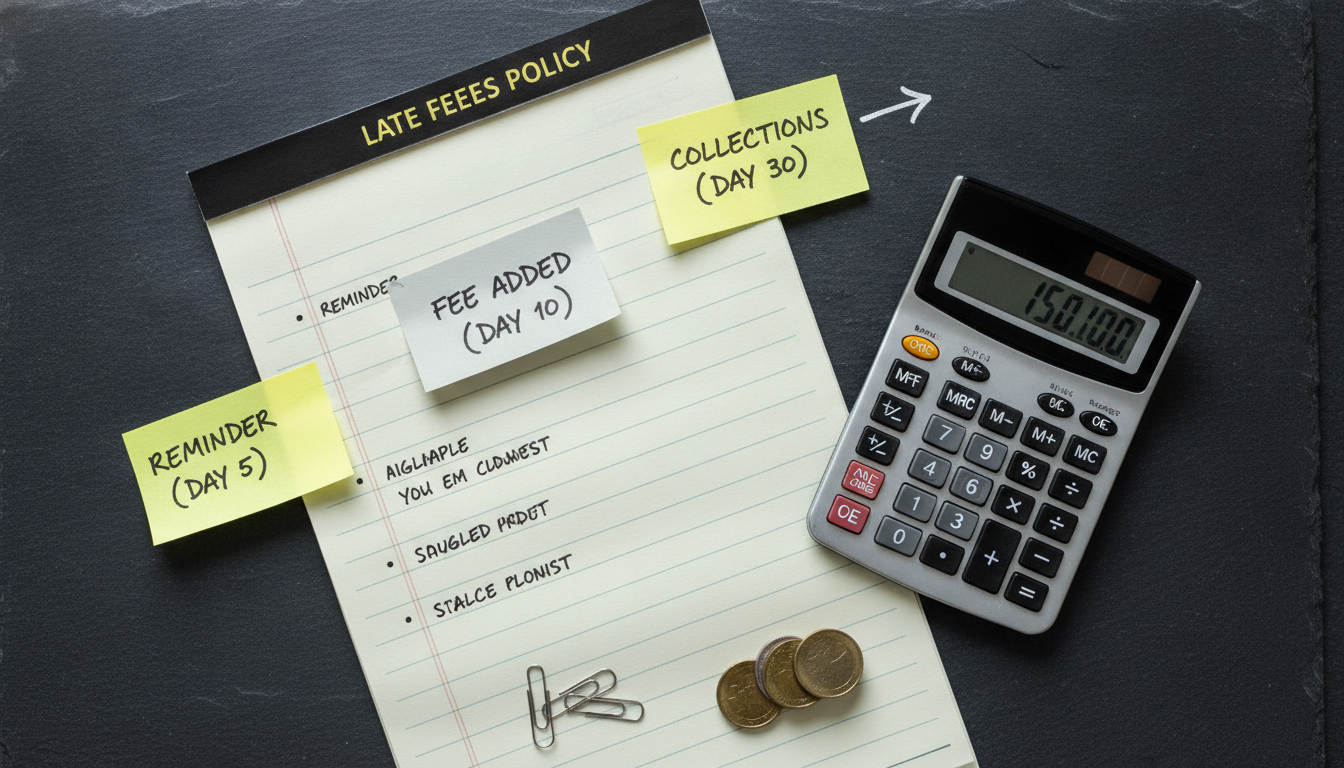
The best way to introduce a late‑fee policy is before any invoice is sent, then repeat it in writing on every estimate, contract, and invoice. Lead with benefits (predictable scheduling and smoother delivery), not punishments. Keep the tone firm yet friendly and automate gentle reminders that start a few days before the due date. People forget. Systems help them remember. When your message is consistent and polite, most clients won’t object, and you’ll avoid awkward, last‑minute haggling over fees.
One approach is to weave your late payment fee clause into the “how we work together” narrative during onboarding. Example language: “Our invoices are Net 15. To keep projects moving, payments after the due date incur a $25 fee plus 1% per month. We send reminders ahead of time so nothing slips.” That positions the fee as part of a well‑run process.
Timing matters. Introduce the terms in your proposal, confirm in your service agreement, and print the clause on each invoice. Email reminders should be short and helpful. Try three touchpoints: a pre‑due nudge, a same‑day reminder, and a polite “past due” note. For retainer clients, recurring billing plus polite dunning is often the easiest fix. For tactics on timing and tone, see Recurring Subscriptions with Stablecoins: Setup and Dunning Best Practices.
And yes, software can help you execute without sounding robotic. Some platforms, like the SeevCash App, let freelancers schedule pre‑due nudges and post‑due notices that reference your exact clause, while keeping message tone and branding consistent. Treat that as one tool among many, not a replacement for judgment.
What does this look like in real life? Before: a videographer waits until an invoice is two weeks late, then sends a stressed email. After: the videographer has a signed scope with the clause, reminders go out automatically, and the fee applies only if the client ignores all three prompts. Notice how the tone stays calm because the process is clear.
If you accept crypto from international clients, a brief line on network congestion and confirmation times can prevent “the payment is pending” confusion. Point clients toward fast‑settlement options and, where appropriate, stablecoins. For workflows that reduce friction, see How to Invoice in USDC and Reduce Payment Delays.
That cause‑effect chain—early disclosure, written terms, consistent reminders—sets up the legal piece, which is about to matter.
Legal Considerations
Charging late fees is generally legal, but the details vary by region and by the type of transaction. Three principles keep you safe: disclose the fee in advance, keep it reasonable, and follow local caps. In the European Union, the Late Payment Directive entitles you to at least 8% above the central bank reference rate and a €40 minimum compensation for recovery costs. In the UK, statutory interest is 8% above the Bank of England base rate for B2B late payments. In the United States, there isn’t one national cap; states set the boundaries, and many freelancers choose 1%–1.5% per month since that’s within legal limits in many jurisdictions when agreed in writing. (eur-lex.europa.eu)
Start with enforceability. Courts often view late fees as liquidated damages, a pre‑agreed estimate of your costs for delayed payment, so the amount must be reasonable, not punitive. This is why stating the fee in the contract or master services agreement, and then repeating it on invoices, is vital. Without prior agreement, collecting a surprise fee is difficult and, in consumer contexts, often prohibited. (legalclarity.org)
Next, consider electronic agreements. Under the U.S. ESIGN Act, a contract “may not be denied legal effect… solely because it is in electronic form,” and an “electronic signature” includes any electronic sound, symbol, or process adopted with intent to sign. That means your client can accept your terms online, and you can keep records digitally as long as you preserve access. Many states also follow the Uniform Electronic Transactions Act with similar rules. (law.cornell.edu)
Regional examples help. In the EU, the default statutory interest and €40 compensation kick in automatically for commercial transactions, unless otherwise agreed and provided your terms are clear. In the UK, the Late Payment of Commercial Debts (Interest) Act 1998 sets the interest as 8% plus the base rate. Both frameworks aim to prevent larger buyers from dragging out payments to smaller suppliers. (eur-lex.europa.eu)
In the U.S., state usury and commercial codes drive the limits. Many states permit 1%–1.5% per month in commercial settings if the contract says so, but some set lower ceilings or special rules. Because statutes evolve, treat any checklist you find online as a starting point, not a final answer. When in doubt, call a local attorney or accountant once to confirm your rate and wording.
One behavioral footnote belongs in legal strategy: clarity reduces disputes before they start. Clients don’t contest fees they can see coming. That is your best legal defense and your easiest win.
Compliance note: Regulations change, and certain industries or consumer transactions may have special rules. Confirm your policy with a qualified professional in your jurisdiction before you enforce it.
With the guardrails in place, let’s turn your policy into words you can ship today.
Sample Late Fees Policy Template
A practical template for a late‑fee policy should be short, precise, and easy to personalize. The essential fields are due date, grace period, the late payment fee clause, calculation method, escalation steps, and accepted payment methods. Keep the language aligned with your voice. Clients respond to clarity and tone more than legalese. If you maintain a freelance invoice terms template, drop this section into it so every client sees the same standards.
Here’s a fill‑in‑the‑blank template you can adapt:
Late Fees Policy for [Your Business Name]
-
Payment Terms • Invoice Date: [MM/DD/YYYY]
• Due Date: [MM/DD/YYYY] (Net [15/30])
• Grace Period: [X] days after the due date -
Late Payment Fee Clause • If payment is not received by the end of the grace period, a late fee of [flat $ amount] will apply, plus [X%] per month on any unpaid balance beginning [date].
• Example: A [$ amount] invoice, [30] days past due, incurs [$ flat fee] plus [X%] of [$ amount] = [$ amount]. -
Interest and Calculation • Interest is calculated [simple/compounded] on the unpaid balance on the [monthly] cycle.
• Interest and fees stop accruing once the balance is paid in full. -
Reminders and Escalation • Automated reminders are sent [3 days before due / on due date / 5 days after due].
• If the account remains unpaid [45/60] days after the due date, work may pause until payment is received. Accounts [90] days past due may be referred for collection or legal action. -
Accepted Payment Methods • [ACH / card / wire / crypto], with payer responsible for any bank or network fees.
• For crypto payments, settlement currency is [USDC/BTC/ETH] on [chain], with payment considered received after [X] confirmations. -
Dispute Window • Any invoice questions must be raised within [7] days of receipt.
-
Agreement • By approving the estimate, signing the agreement, or paying the initial invoice, Client accepts these payment terms.
Signature: [Name, Title, Date]
Two quick adjustments make this template yours. First, match the reminder schedule to your work rhythm and client size. Second, adjust the fee structure to your typical invoice amount. On small, fixed‑price projects, a flat $15–$25 may feel fair. On larger retainers, 1%–1.5% per month is common where legal. Include one plain‑language example per invoice so no one needs a calculator. (legalclarity.org)
Before: you copied a vague clause from an old contract and hoped for the best. After: your policy template lives in your invoice system, every client signs identical terms, and reminders run without drama. Some platforms like SeevCash Plus can attach the policy as a click‑to‑accept addendum and log that acceptance, making retention and audits painless for growing teams that need a paper trail.
Two pitfalls to avoid: hiding the clause in dense text and changing the fee mid‑project. If you ever waive a fee as a courtesy, say so explicitly and note that it doesn’t waive future enforcement. That preserves the boundary and the relationship.
For freelancers who invoice in crypto or across borders, it helps to spell out payout rails and timing to prevent “I sent it yesterday” disputes. Not sure what to include? See Crypto Invoice Generator: What to Include and How to Send and Reduce Failed Payments and Fraud in Crypto Invoicing.
Common Questions About Late Fees Policies
What is a late fees policy?
A late‑fees policy outlines the charges applied when clients don’t pay invoices on time, including the grace period, the amount (flat, percentage, or both), how interest accrues, and what happens if nonpayment continues. The goal is to encourage timely payment, not to punish, and to make expectations transparent so projects keep moving. The heart of it is a clear late payment fee clause placed where clients will read it.
Are late fees legal?
Yes, when set out in advance and within legal limits. In the EU, statutory interest for commercial late payment is at least 8% above the European Central Bank’s rate plus a €40 minimum recovery compensation. In the UK, it’s 8% above the Bank of England base rate for B2B late payment. In the U.S., states set different caps; many freelancers choose 1%–1.5% per month when agreed in writing. (eur-lex.europa.eu)
How much should I charge for late fees?
It varies with invoice size and local law. A flat $15–$50 works for smaller projects, while 1%–1.5% per month scales better for larger balances where permitted. Include a simple example beneath your clause so clients can see how it’s calculated, and confirm the rate is acceptable in your jurisdiction before you enforce it. (legalclarity.org)
How can I enforce my late fees policy without upsetting clients?
Start with early, friendly disclosure during onboarding. Place the clause in your agreement and on every invoice, and send polite, scheduled reminders around the due date. Emphasize that the policy supports predictable scheduling and lets you serve clients better. Most disputes evaporate when expectations are known ahead of time, and documented reminders keep the tone calm and professional.
Do this today: add the bolded one‑line clause below to your next estimate and invoice, then set three reminders.
Suggested clause: “Payments received after [grace period] days from the due date incur a $[flat fee] late charge plus [1%–1.5%] per month on any unpaid balance.”
If you want a repeatable workflow, add the full policy template above to your contract, link it on every invoice, and save time with a reminder cadence that starts three days before the due date. If you prefer software assistance, platforms like SeevCash can help you trigger reminders and capture consent, but the heart of on‑time payment is still the same: clear terms, politely enforced.
Sources and notes for the curious:
- Xero Small Business Insights data and commentary on late payment durations and ongoing challenges. (xero.com)
- UK statutory interest of 8% above the Bank of England base rate for B2B late payment. (gov.uk)
- EU Late Payment Directive minimum interest and €40 compensation for recovery costs. (eur-lex.europa.eu)
- Prevalence of late invoices (49.3%) across a large UK sample. (freeagent.com)
- Prospect theory and loss aversion as a behavioral basis for why stated penalties can reduce lateness. (ucl.ac.uk)
- ESIGN Act provisions supporting electronic contracts and signatures for U.S. freelancers. (law.cornell.edu)
If you want to go deeper on cash‑flow timing, cross‑border payments, and dunning cadence, explore these resources next:
- Payment Terms (Net 15 vs Net 30) and Cash Flow Strategy for Freelancers
- Recurring Subscriptions with Stablecoins: Setup and Dunning Best Practices
- How to Invoice in USDC and Reduce Payment Delays
- Crypto Invoice Generator: What to Include and How to Send
- Reduce Failed Payments and Fraud in Crypto Invoicing
Your clients can only follow the rules they can see. Put yours in writing, make them easy to follow, and start collecting on time.